
Google Local Services Ads vs. Google Ads: What Local Service Businesses Need to Know Before Spending a Dollar
Type "plumber near me" into Google and look at what comes back. Before the map, before the regular ads, before a single organic result, there's a row of businesses with star ratings, a blue verification checkmark, and a call button. That's Google Local Services Ads — the highest position on the page, and for most local service businesses, the most misunderstood.
Below that row sit the traditional Google Ads. Different product, different pricing model, different job. Owners lump them together as "being on Google," pick one based on what a competitor is doing, and then wonder why the phone rings with the wrong calls or doesn't ring at all.
This post breaks down how each platform actually works right now, what changed in the last eighteen months (a lot), and — more importantly — what needs to be true about your business before either platform will pay for itself. Because here's the thing we say to every client: the ad platform is rarely the problem. The system catching the leads usually is.
The two machines, in plain English
Google Local Services Ads (LSAs) are pay-per-lead. You don't bid on keywords, you don't build landing pages, and you don't pay for clicks. Google verifies your business, places you at the very top of local search results, and charges you when a customer actually calls or messages you through the ad. Someone sees your ad and doesn't reach out? You pay nothing. The customer never even visits your website — the lead goes straight to your phone.
Google Ads (search ads) are pay-per-click. You bid on keywords, write the ad copy, and send traffic to a landing page you control. You pay every time someone clicks, whether they call you or bounce in four seconds. More control, more moving parts, more ways to burn budget — and more room to win when it's built right.
The simplest way to think about it: LSAs intercept the emergency. Google Ads capture the research. A burst pipe at 9pm is an LSA lead — the homeowner wants a verified company that answers now. A homeowner comparing water heater replacement quotes over two weeks is a Google Ads opportunity — they're clicking, reading, and comparing, and your landing page gets to make the case. The strongest local businesses eventually run both, because they cover different moments in the same customer's journey.

What changed — and why most advice you'll read is outdated
Google quietly rebuilt LSAs in pieces between 2024 and 2026, and if you set up an account under the old rules, you're likely paying for it.
The Google Guaranteed and Google Screened badges are gone. In October 2025, Google retired both and replaced them with a single blue "Google Verified" checkmark — and discontinued the money-back guarantee that came with the old green badge. Verification still requires background checks, license verification, and proof of insurance, and it still takes a few weeks. But the marketing value now rides entirely on the checkmark plus your reviews.
Your Google Business Profile is no longer optional. Since late 2024, a linked, verified GBP is mandatory to run LSAs at all. If your profile is incomplete, unverified, or gets suspended, your ads stop. And as of mid-2025, LSA reviews merged into your Business Profile — meaning your GBP reviews are now the review signal that determines your LSA ranking. One review engine now powers both your map pack presence and your paid placement.
Lead credits got automated — and stingier. The old "Report a Problem" dispute button is gone, replaced by an AI system that issues automatic credits for invalid leads. Meanwhile, Google eliminated credits for out-of-area calls and job types you don't service. Any call lasting 30 seconds or more bills as a lead, no exceptions — including the polite 90-second call where your office explains you don't cover that zip code. The only defense is keeping your service areas and job-type settings surgically tight, and rating bad leads within 30 days through the feedback system.
Costs have matured. Industry benchmarks in early 2026 put home-service LSA leads in the range of roughly $25–$80 depending on trade and market, with blended averages around $50 and book rates in the 40% neighborhood for businesses that answer fast. That's still meaningfully cheaper per acquired customer than typical non-branded search ads — but the era of cheap, easy LSA leads is over. New entrants are competing against businesses with years of accumulated reviews and response history.
Tips before you turn on LSAs
Get your review engine running first. Reviews are the dominant ranking signal, and businesses with strong volume and high averages consistently outrank thinner profiles. If you have nine reviews and your competitor has ninety, your ad shows less and converts worse. Build the post-job review ask into your process — a text within 24 hours of a completed job, every job — before you spend a dollar on leads. And never incentivize reviews; a suspended GBP now takes your ads down with it.
Answer in seconds, not hours. Google tracks your responsiveness and ranks you on it, and customers calling three providers hire the first one who picks up. If nobody can reliably answer the phone during business hours — or worse, after hours when emergencies happen — LSAs will bill you for leads your competitors close. This is where an AI answering and instant text-back system stops being a luxury and starts being the difference between a 20% and 45% book rate on the same ad spend.
Set your service area like you're paying for every mistake — because you are. With geo credits gone, a loose service area is a monthly tax. Map your real coverage by zip code, list only the job types you genuinely want, and review the settings quarterly.
Budget weekly, judge monthly. LSA budgets run on a weekly cadence and the system needs data to learn which leads fit your business. Give it 30 days at a consistent budget before you judge it, and measure cost per booked job — not cost per lead. A $60 lead at a 45% book rate is a better deal than a $40 lead at a 20% book rate.
Tips before you turn on Google Ads
Never send paid clicks to your homepage. Search ads only work when the click lands on a page built for that exact intent — a water heater page for water heater searches, with the offer, proof, and a call button above the fold. Sending a $15 click to a generic homepage is how budgets disappear without a trace.
Negative keywords are half the job. Without them you'll pay for "DIY," "how to," "jobs," and every other search that will never become a customer. A well-maintained negative list is often the fastest ROI improvement in an underperforming account.
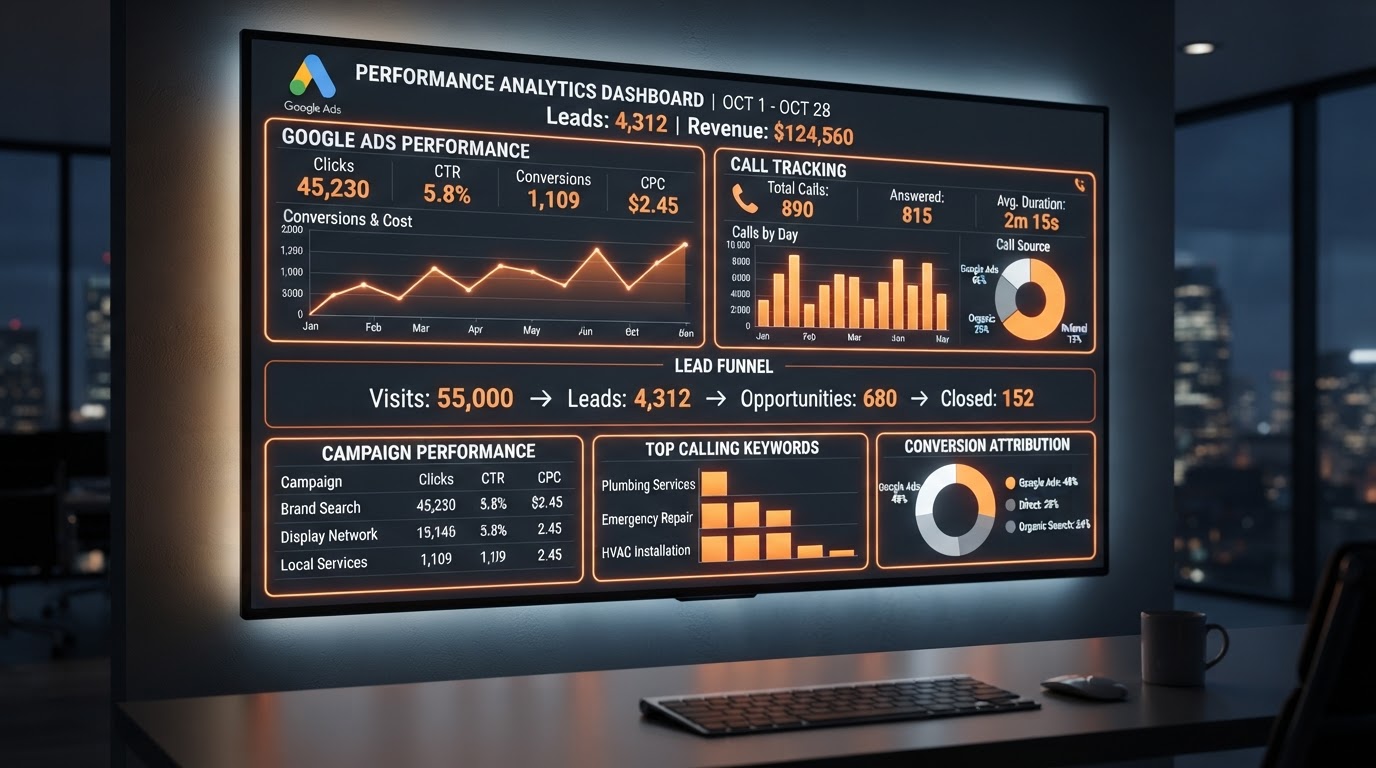
Track calls, not clicks. If you can't tie a keyword to a booked job, you can't optimize anything — you're just admiring traffic. Call tracking and conversion tracking wired into your CRM is the non-negotiable foundation. This is the single most common gap we find when auditing accounts: the campaign has data, the business has revenue, and nothing connects the two.
Expect a learning period and budget for it. Search ads reward the advertiser who can feed the algorithm enough conversion data to optimize. Thin budgets spread across too many campaigns never exit the learning phase — one of the most common silent killers we see. Fewer campaigns, tighter focus, sufficient budget.
The part nobody tells you: the platform is only half the machine
Here's the pattern we see over and over when businesses come to us frustrated with "Google not working." The ads were fine. The leads were real. But the calls went to voicemail at 6:05pm, the missed caller never got a text back, the quote never got a follow-up, and the review never got asked for. The business paid for the lead and the competitor got the job.
Both platforms have gotten less forgiving — LSAs bill you for 30-second calls and Google Ads punish thin conversion data. That means the businesses winning on Google in 2026 aren't the ones with the biggest budgets. They're the ones with the tightest systems: instant response to every lead, automated follow-up on every quote, a review ask after every job, and tracking that connects ad spend to booked revenue.
That's the machine we build. When Cosmoflare takes a business onto Google, we don't just launch ads — we reverse engineer the full path from search to booked job: the verified profile and review engine that powers your ranking, the LSA and Google Ads configuration matched to how your customers actually buy, the speed-to-lead automation that answers and follows up instantly, and the reporting that shows you cost per booked job, not vanity metrics.
Quick answer: which one should you start with?
If you're a licensed trade in an eligible category with a healthy review base and someone who can answer the phone fast, start with LSAs — the verified top-of-page placement and pay-per-lead model is the most efficient entry point. If your work is planned-purchase and higher ticket, or your category isn't LSA-eligible, start with Google Ads and a purpose-built landing page. If you're established and serious about owning your market, the answer is both, run as one connected system — LSAs catching the emergencies, search ads winning the research phase, and one CRM catching everything.
But whichever door you walk through first: build the system before you buy the traffic. Leads you can't catch aren't leads. They're donations to your competitors.
Ready to see where your Google presence is leaking?
We'll audit your profile, your ad accounts, and your lead response system — and show you exactly what's blocking booked jobs.